Cabinet manufacturing facilities present unique safety challenges: large open floor plans, heavy equipment, loud ambient noise, and a workforce spread across both production and administrative areas. When the unthinkable happens — an active shooter incident — the ability of employees to respond quickly and decisively can mean the difference between life and death. This article draws on best practices shared by members of the Kitchen Cabinet Manufacturers Association (KCMA) Safety Subcommittee to help cabinet manufacturers develop, implement, and maintain an effective active shooter preparedness program.
Building Your Program: Start with a Foundation
One effective approach is to grow an active shooter plan out of a broader workplace violence prevention program. Beginning with workplace violence gives your safety team a framework for recognizing warning signs, reporting concerns, and escalating threats — all of which apply directly to active shooter scenarios. From that foundation, the active shooter plan adds specific response protocols and physical preparedness measures.
Two key federal resources are available to help manufacturers get started at no cost:
- The Department of Homeland Security (DHS) provides a customizable active shooter plan template that can be adapted to your facility’s specific layout, personnel, and operations.
- FEMA’s Emergency Management Institute offers the free online course IS-907.A: Active Shooter: What You Can Do, which provides a strong educational baseline for employees at all levels.
The Core Response Decision: Hide, Run, or Fight
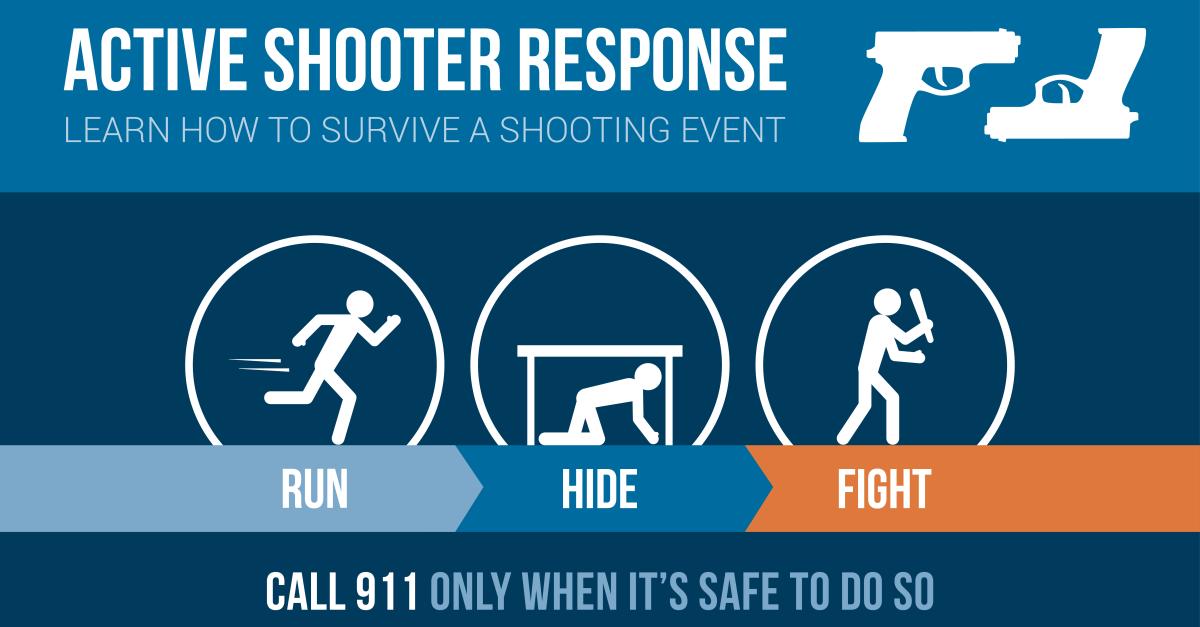
Every active shooter plan might consider communicating a clear decision-making framework to employees. The widely adopted model presents three options, roughly in order of preference based on circumstances:
- Run: Evacuate the building if a safe escape route exists. Leave belongings behind, help others when possible, and call 911 once safely outside.
- Hide: If evacuation is not possible, find a secure location. Lock and barricade doors, silence phones, turn off lights, and stay out of sight.
- Fight: As a last resort, when your life is in immediate danger, act aggressively to disrupt and incapacitate the threat. Use any available objects as improvised weapons.
Signs posted visibly throughout your facility — in office areas, break rooms, and on the production floor — can reinforce this framework. Each sign might include the room number, a map of the immediate area, and the relevant response options so that employees can orient themselves quickly under stress.
The Active Shooter Kit: Equipping Your Facility
A purpose-built Active Shooter Kit ensures that critical resources are available immediately when needed. Some KCMA member companies store these in a waterproof, fireproof Pelican case for durability and quick identification. A well-stocked kit typically includes:
- First aid and trauma aid materials (tourniquets, pressure bandages, wound-packing gauze)
- Under-door security card (a rigid card that prevents doors from being opened from outside)
- Window breaker (for emergency egress through glass)
- Flash drive containing your written active shooter policy, a current employee list, and a detailed facility map
- Calling tree for internal and external notifications
Consider kit placement carefully. Units might be most useful when readily accessible in key areas — near main entrances, in supervisory offices, and at points of likely shelter-in-place on the production floor.
Communication Planning: Who to Call and When
A notification plan might consider addressing three layers of communication:
- Internal company: Designated employees — typically security, HR, and senior management — who coordinate the response and account for personnel.
- External company contacts: Corporate security, legal, communications/PR, and employee assistance program (EAP) providers.
- Public emergency personnel: Local police, fire department, and emergency medical services.
A pre-established calling tree — stored both in the Active Shooter Kit and electronically — removes ambiguity about who contacts whom. Include cell phone numbers, as landline systems may be unavailable.
Training: From Employees to First Responders
A written plan alone is insufficient. Employees must be trained to respond instinctively under the extreme stress of a live incident.
Employee Training
Designate specific individuals in your facility as trained response leaders who can guide colleagues during an incident. ALERRT (Advanced Law Enforcement Rapid Response Training) offers a nationally recognized civilian response curriculum, and the Mental Health First Aid program can help employees support one another in the aftermath of a traumatic event.
Engaging Local Law Enforcement and Fire Departments
Proactively partnering with your local police and fire departments is one of the highest-value steps a facility can take. Invite them to:
- Tour your facility so they understand the layout before an emergency occurs
- Review your floor plan and emergency exit points
- Receive a copy of your contingency plan
- Potentially provide on-site training for your workforce
Many local departments are eager to engage with major employers in their jurisdiction and will participate in tabletop exercises or walk-through drills at no charge.
Facility Security: The Physical Layer
Active shooter preparedness does not begin the moment a threat enters your building — it begins with making it harder for a threat to enter in the first place. Manufacturing facilities vary considerably in their existing security posture, but all might consider evaluating the following:
- Controlled entry points: Designate a single secured entrance for visitor access with a reception or guard checkpoint.
- Perimeter fencing: Fencing around the facility and parking areas limits unauthorized vehicle and pedestrian access.
- Secured interior doors: Key card or badge access for interior zones separates production areas from offices and limits internal movement for unauthorized individuals.
- Ventilation-compatible security: In manufacturing environments, adequate airflow is a safety requirement. Secure gates and doors that still permit necessary airflow — consult your facilities and EHS teams when specifying hardware.
Getting Started: A Practical Checklist
For facilities beginning or refreshing their active shooter program, the following steps provide a starting point:
- Download and customize the DHS active shooter plan template for your facility
- Enroll key safety personnel in FEMA IS-907.A online
- Post Hide/Run/Fight signage with room numbers and facility maps
- Assemble Active Shooter Kits and distribute to key locations
- Develop a three-tier communication/calling tree
- Identify and train designated response leaders using ALERRT curriculum
- Invite local law enforcement for a facility walk-through and plan review
- Audit physical security: entry control, fencing, and door locking hardware
- Schedule annual drills and plan reviews to keep readiness current
No facility can prevent every threat, but a well-prepared workforce and a thoughtfully designed plan dramatically improve outcomes. The KCMA Safety Subcommittee encourages all member companies to treat active shooter preparedness as a core element of their safety programs — not a one-time exercise, but an ongoing commitment to the people who build America’s cabinets every day.
Key Resources
- DHS Active Shooter Preparedness: www.dhs.gov/active-shooter-preparedness
- FEMA IS-907.A — Active Shooter: What You Can Do: training.fema.gov/is/courseoverview.aspx?code=is-907.a
- ALERRT Course Catalog: alerrt.org/Course-Catalog
- Mental Health First Aid: www.thenationalcouncil.org/our-work/mental-health-first-aid/
THIS DOCUMENT IS PROVIDED BY KITCHEN CABINET MANUFACTURERS ASSOCIATION (“KCMA”) FOR INFORMATIONAL PURPOSES ONLY. ANY INACCURACY OR OMISSION IS NOT THE RESPONSIBILITY OF KCMA. DETERMINATION OF WHETHER AND/OR HOW TO USE ALL OR ANY PORTION OF THIS DOCUMENT IS TO BE MADE IN YOUR SOLE AND ABSOLUTE DISCRETION. PRIOR TO USING THIS DOCUMENT OR ITS CONTENTS, YOU SHOULD REVIEW IT WITH YOUR OWN LEGAL COUNSEL. NO PART OF THIS DOCUMENT CONSTITUTES LEGAL ADVICE. USE OF THIS DOCUMENT IS VOLUNTARY. KCMA DOES NOT MAKE ANY REPRESENTATIONS OR WARRANTIES WITH RESPECT TO THIS DOCUMENT OR ITS CONTENTS. KCMA HEREBY DISCLAIMS ALL WARRANTIES OF ANY NATURE, EXPRESS, IMPLIED OR OTHERWISE, OR ARISING FROM TRADE OR CUSTOM, INCLUDING, WITHOUT LIMITATION, ANY IMPLIED WARRANTIES OF MERCHANTABILITY, NONINFRINGEMENT, QUALITY, TITLE, FITNESS FOR A PARTICULAR PURPOSE, COMPLETENESS OR ACCURACY. TO THE FULLEST EXTENT PERMITTED BY APPLICABLE LAWS, KCMA SHALL NOT BE LIABLE FOR ANY LOSSES, EXPENSES OR DAMAGES OF ANY NATURE, INCLUDING, WITHOUT LIMITATION, SPECIAL, INCIDENTAL, PUNITIVE, DIRECT, INDIRECT OR CONSEQUENTIAL DAMAGES OR LOST INCOME OR PROFITS, RESULTING FROM OR ARISING OUT OF A COMPANY’S OR INDIVIDUAL’S USE OF THIS DOCUMENT, WHETHER ARISING IN TORT, CONTRACT, STATUTE, OR OTHERWISE, EVEN IF ADVISED OF THE POSSIBILITY OF SUCH DAMAGES.